




























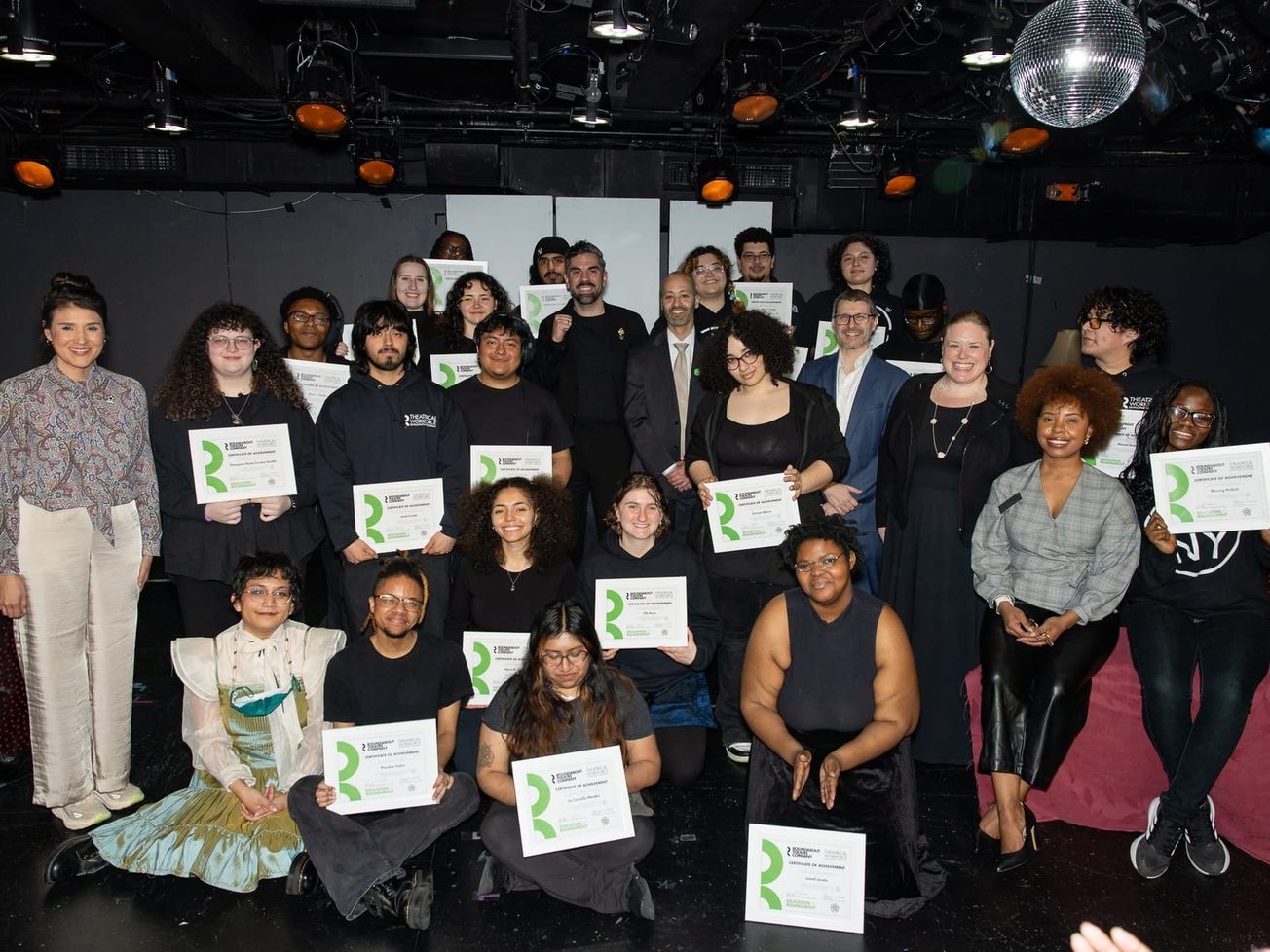
When Rafael Espinal, commissioner of the New York City Mayor’s Office of Media and Entertainment (MOME), was growing up in the Cypress Hills neighborhood of Brooklyn, he dreamed of being a creative worker in his home city. But, as Commissioner Espinal told Broadway News, “the pipeline, tools, opportunities weren’t really clear to folks like me,” and so after studying film in undergrad but unable to find a path towards an actual filmmaking career, he went into politics. That’s the reason the commissioner showed up at Roundabout Theatre Company’s black box space at the Harold and Miriam Steinberg Center on April 24 — to watch the final presentation by a cohort of trainees who had been given a pathway to work in the creative arts.
These trainees are members of the Theatrical Workforce Development Program (TWDP) tech division, an initiative that launched in 2016 to offer vocational training in backstage work, specifically in four areas: scenic carpentry, lighting/electric, audio and wardrobe. The program was spearheaded by Roundabout Theatre Company, who recruited partners like the International Alliance of Theatrical Stage Employees (IATSE, the union for professional backstage laborers), MOME, the New York City Department of Small Business Services (SBS) and more. TWDP is part of Roundabout Theatre Company’s annual investment of over $4 million in education and community partnerships.
One impetus for the program was the goal of diversifying the theater’s backstage work environment. While the program is open to all New York residents, the Roundabout website emphasizes its encouragement of those from historically underrepresented groups to apply. The training program doesn’t require a college degree and it pays participating fellows.
It made sense for Roundabout to take on this vocational training since the company’s education department was already teaching technical theater skills in high schools throughout the five boroughs through Producing Partners Residencies and On-Site Experiences. “We were well-positioned to launch this program, because we had been teaching tech people theater for many years in the city prior to 2016,” said Jennifer DiBella, Roundabout’s director of education. “Our teaching artists [going into the high schools] are working professional artists, technicians and designers.” Many of those same teaching artists could easily take on instruction for TWDP.
TWDP is a three-year program that consists of a training year, job development year and freelance year. The first year begins with a six-week “Made in New York” boot camp, supported by MOME. Throughout the fellowship, each trainee, or fellow, learns across the four tech disciplines — specializing in one — and is matched with a TWDP alumnus as well as an IATSE mentor. The 2026 cohort is the eighth since the program started a decade ago (due to the pandemic disruption).
Fellows learn practical tech skills required for a backstage job and gain financial and logistical counsel about actually working in the business.
“We have IATSE professionals work with the fellows, help them navigate all of these things about the industry that are so important and difficult,” said Jeff Kennedy, international representative for IATSE. During boot camp, fellows spend two days at the IATSE offices and learn about the union, its rules and contracts.
“If you were working gig to gig, you might make a ton of money in six weeks and then you have a drag period, right? So how do you plan for that?” DiBella pointed out. “What are the skills you need to be a good technician? Not just the hard skills, but also the sort of transferable [business] skills.”
“There’s financial benefits in that but also safety,” Kennedy said, since all fellows receive the OSHA-30 certification from the Occupational Safety and Health Administration through the program.
Looking around the black box of the Steinberg Center, fellows were clearly taking safety seriously as they prepared for their presentation. They were about to put on a selection of scenes from Joshua Harmon’s play “Significant Other,” but instead of focusing on the actors, the audience would focus on the technical elements required to make those actors shine. There were no curtain legs covering the wings. The audience could watch dressers help actors with costume changes and see stagehands move set pieces built by the fellows. The lighting and sound boards were lit so viewers could see operators implement changes. The stage manager was mic’d, so that we could hear them call cues that normally go unheard by audiences — highlighting the discipline of stage management and the collaboration between every department that had to listen for and follow these instructions.
“We’ve kind of left everything out in plain sight rather than tucking it away in a booth or backstage so that the technicians can be featured,” said DiBella. “The magic is all around us.”
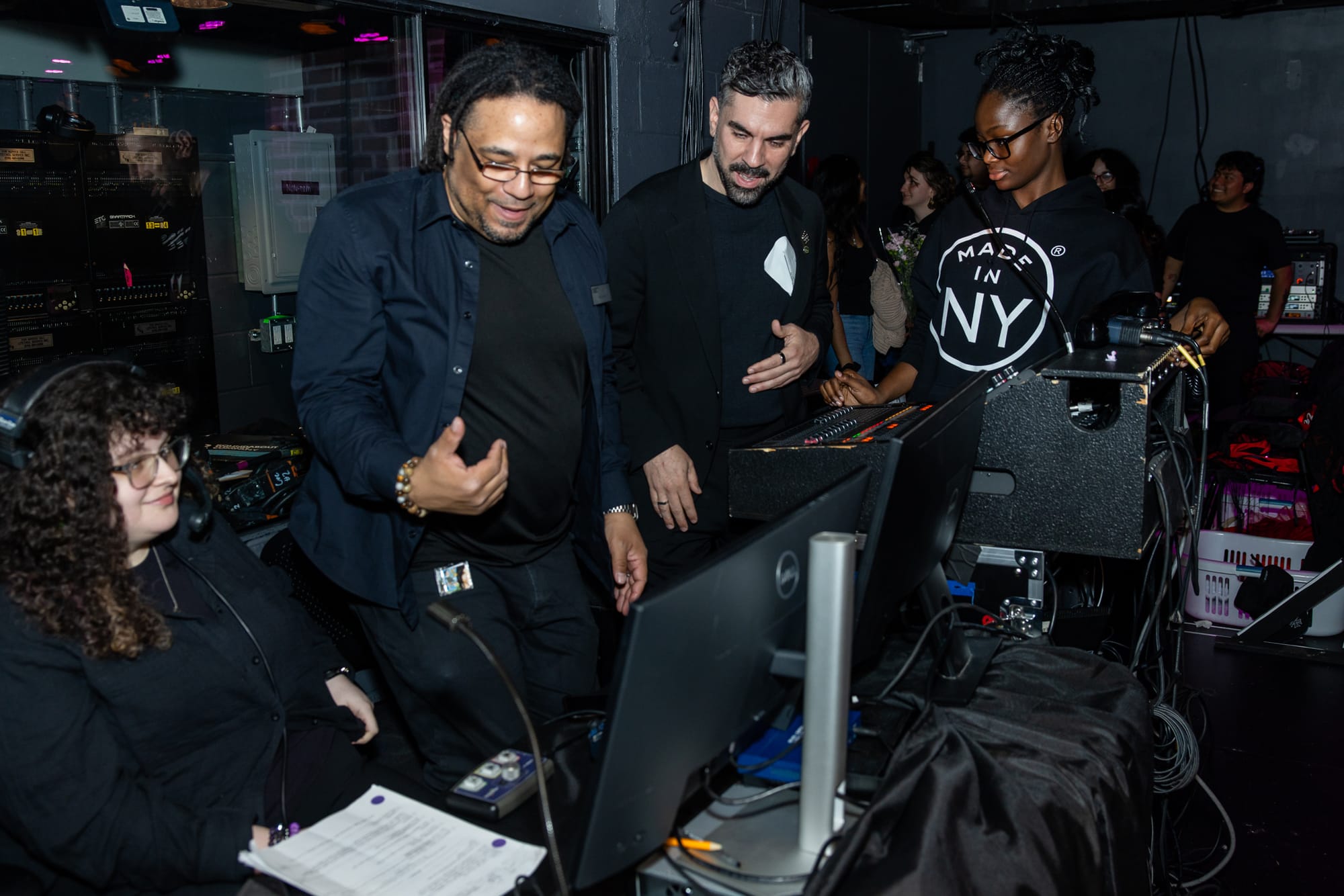
That magic is what attracts TWDP fellows — present and past. “When I went to college, I didn’t know what route I wanted to take,” said TWDP alumnus Leslie Recinos. “In high school, I was a part of my stage group and I also was in a boat-building program, so I learned carpentry skills. I went to see ‘Wicked,’ and I got really interested in the scenic side. Then I just did a deep dive on YouTube. [And I thought], ‘How do I get into this?’”
Recinos searched for programs that could help her achieve her behind-the-scenes goals and found TWDP. Today, Recinos is a house electrician at Manhattan Theatre Club’s Stage 1, having served as automation operator on the fall 2025 production of “Queens,” for example, while freelancing as an electrician and maintaining her position as a teaching artist with Roundabout.
“I really treasure that I was given a well-rounded education around these crafts in technical theater,” Recinos said of TWDP. “As an electrician, you hire me as an electrician, but I also have these carpentry skills.” Alumnus Finneas Weeks Manjarres, who is on the projections team with the Metropolitan Opera and is a Roundabout teaching artist, has also brought instruction in projection design to TWDP.
Kenton Weeks, a member of the 2026 cohort, said he’s learned to be more punctual and generally professional — in addition to his specialized wardrobe abilities. “[It taught me] how to prioritize my time for different things — not only in work life,” Weeks said. Alumnus Marcus Gamboa learned to “always ask questions,” which has gotten him far. Gamboa is an electrician at the Orpheum Theatre Off-Broadway.
According to DiBella, 89 percent of people who have gone through TWDP are still working in the industry, on and Off-Broadway, and 18 percent have already joined IATSE. “One of the really exciting things too is upward economic mobility, because these are middle-class jobs,” said DiBella. “When our fellows are leaving the program, they’re making between $38 and $50 an hour but that can be $150 an hour with full time.”
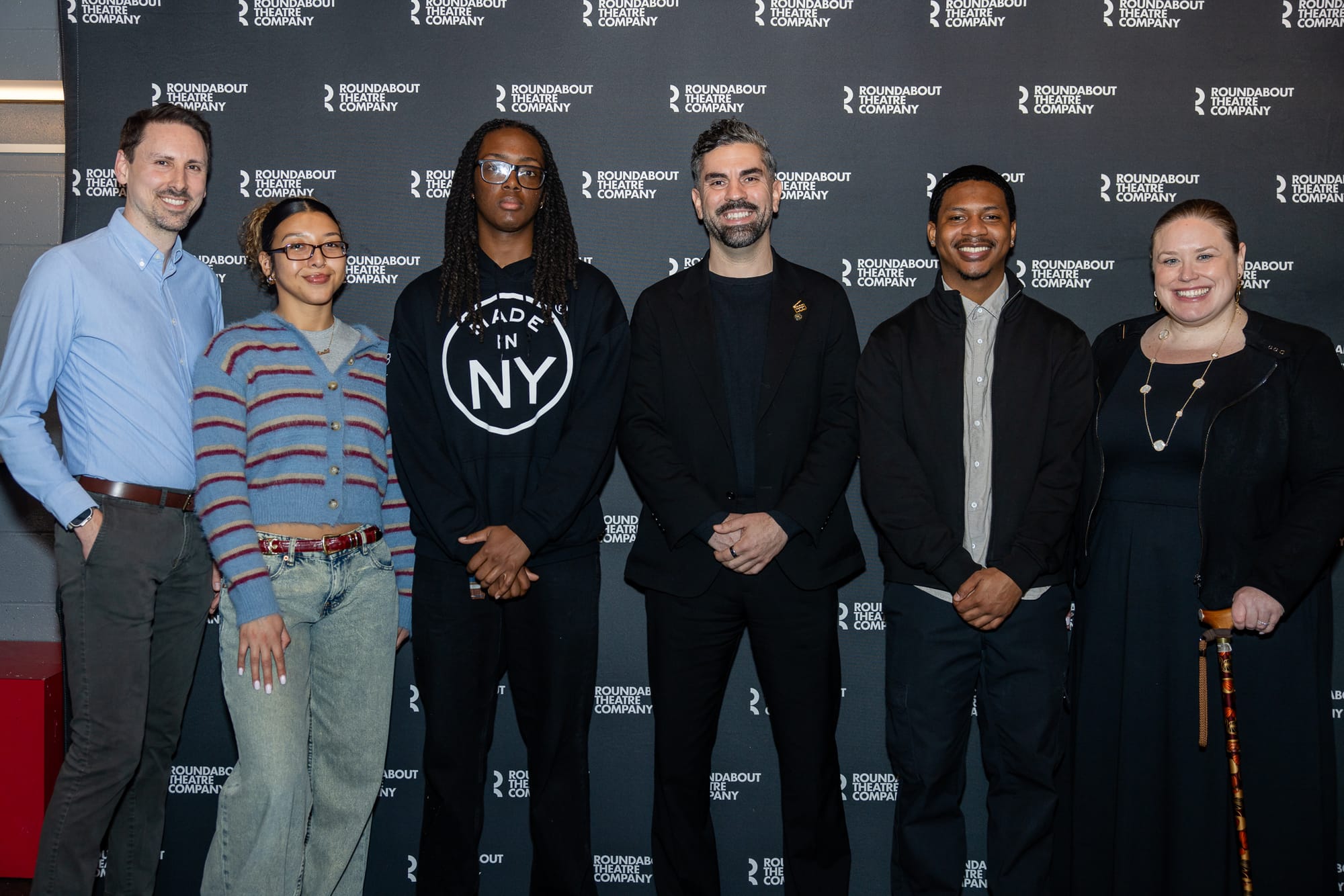
Since 2016, TWDP has trained more than 150 technicians for backstage careers in the live arts and alumni have worked across nearly 100 nonprofit theaters in New York City. Recruitment for the ninth cohort, which will begin training in September, is now under way. The final information session will take place on May 14. (Attending an info session is a required step of the application process.)
“I came into this role with the vision and with the lens of how do we create more access?” said Espinal. “So programs like this really speak to what I’m hoping to continue supporting and expanding to ensure that children and young people from all across all corners of the city have these opportunities — whether it’s on Broadway, film, music, etc.”
“Broadway is a beautiful space,” the commissioner continued. “It creates a lot of excitement and positive energy for the city of New York, but I think that it can only be as beautiful as how diverse its cast and crew is.”