












In 1774, Marie Antoinette ascended to the throne as Queen of France and, for much of her reign, lived in the sprawling palace at Versailles. In 2000, socialite Jackie Siegel — who has insisted upon her own place in American royalty — visited the 18th-century palace and was inspired to build her own Versailles — in Florida. Siegel’s quest to build the largest home in America was captured in the 2012 documentary “The Queen of Versailles.” Now, in 2025, Siegel has taken up residence on Broadway as the leading character in a musical of the same name.
Director Michael Arden and book writer Lindsey Ferrentino tell Siegel’s story — one of great ambition and love of material beauty — in parallel to that of Marie Antoinette and King Louis XVI’s French court. For acclaimed fashion designer turned Broadway costume designer Christian Cowan, this conceit created the opportunity not only to create ostentatious looks for the character of Jackie, but to also craft his version of 18th-century courtesans, including Marie Antoinette.
“She was a true fashion icon,” said Cowan. “She was a forward-thinking person. She set all the trends for everyone, and I think she truly had talent — and whoever was making her clothes was truly a genuine genius.”
So Cowan got to have fun while staying true to the period. “Everyone around Jackie is true to life; they are really ordinary people, ordinary clothes,” Cowan explained. “Everyone around Marie Antoinette is true to life. They’re very extravagant period French costumes, but they are true to exact paintings that we found.”
“Marie and Jackie both, in their own narratives, had some sense of delusional aspiration towards this idealized version of life. I wanted that to come through in their costumes,” Cowan continued. “They are the unreal part of this real story. So both of them have the bright, the frothy, the confection looks.”
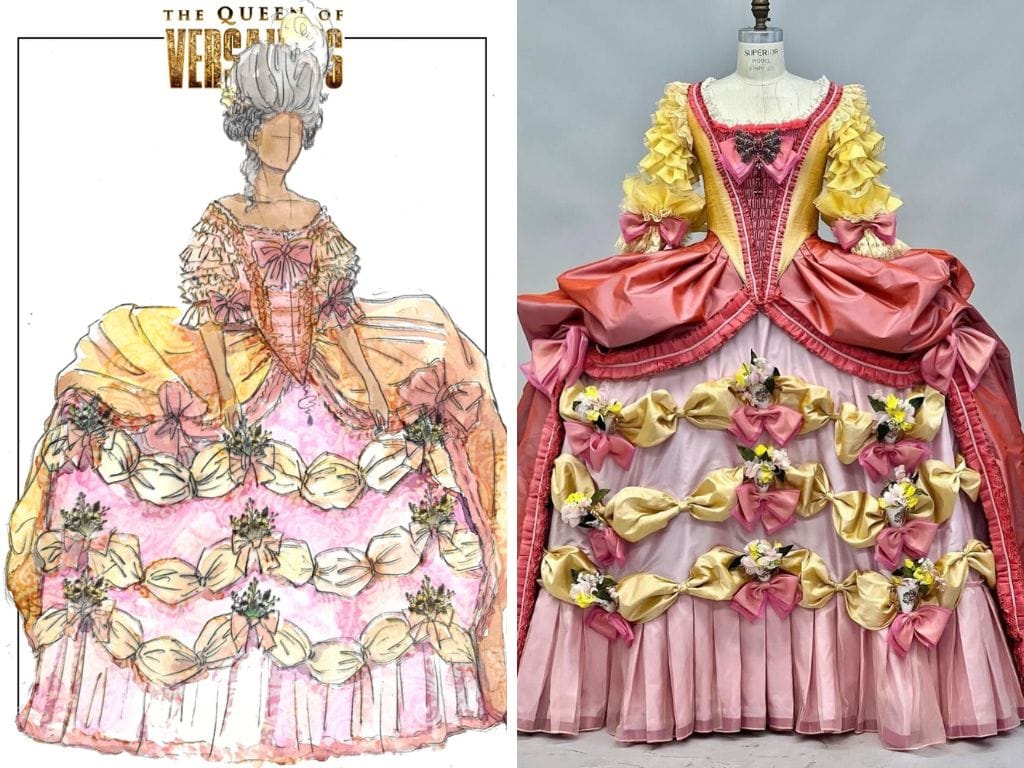
That concept is clearest in Cowan’s design for Marie Antoinette’s finale dress. Though the queen never wore this exact dress, it is inspired by a dress she wore. The wide skirt, the cleavage-enhancing boned corset bodice, the ruffled sleeves all appear in painted portraits that were part of Cowan’s research — as did another extravagant detail. “Apparently, she had this dress where she had had ceramic vases made and sewn all over the dress, and she had fresh flowers [in them],” Cowan described. So the designer decided this costume would have 20 faux-ceramic vases sewn to its skirt as a reference to her extravagance and innovative fashion sense. When it came to choosing the gown’s color palette, Cowan opted for sunset hues. The designer knew he wanted to steer away from images of Marie Antoinette that audiences may have already seen in pop culture. “Everyone loves and knows the Sophia Coppola pastel fantasy,” Cowan said. He wanted something brighter, and the material supported his impulse. “In the song, there’s a reference to the golden hour,” he noted. “It’s all just before the sun sets on their empire, so I was like, ‘Let’s actually lean into that.’” Iridescent oranges, rusts, yellows and pinks create a vibrant, dusk skyline for the dress.
But that’s all on paper. Building the piece is its own story. Cowan and his team, which includes technical costume designer Ryan Park, associate costume designer Amanda Jenks, assistant costume designers Michael Schaffner and Michael O’Herron and costume coordinator Nathalie Olvera — next join forces with veteran costume maker Eric Winterling and members of his team — including workers Oleana, Sasha, Katie, Cora, Misha and Nilima (who chose not to share their last names) — to actually construct the costume. Cowan also tapped designer and artisan Miodrag Guberinic to craft the decorative vases.
Below, Cowan, Winterling and Guberinic reveal the process of building this Marie Antoinette finale gown for actor Cassondra James to wear in “The Queen of Versailles.”