



























As Nathan Lane has made the rounds on the promotional circuit for the current revival of “Death of a Salesman,” he’s shared one story over and over about director Joe Mantello and the genesis of this production. The young director, before he became a two-time Tony Award winner, turned to Lane one day during rehearsals for Broadway’s “Love! Valour! Compassion!” (in which Lane was starring and Mantello was helming) and said, “You know, someday, we’re gonna do ‘Death of a Salesman’ together.”
It may seem natural given Lane’s career that he would one day take on the titanic role of Willy Loman and given Mantello’s trajectory that he would one day take on the demanding Arthur Miller play. But at the time of “Love! Valour! Compassion!,” in 1995, Lane was gaining momentum as a comedy star and Mantello was directing only his second Broadway show (after a financial flop for his directorial debut a year prior). Yet Mantello recalls telling Lane about their future collaboration with a relaxed certainty. “I remember it very distinctly,” Mantello told Broadway News. “It was kind of a passing moment. It wasn’t a deep conversation. It was just this premonition, maybe.”
Sure enough, Mantello’s mounting of “Death of a Salesman” officially opened on Broadway on April 9, starring Lane and now-frequent Mantello collaborator Laurie Metcalf.
But what brought Mantello to the play wasn’t a need to make good on a 30-year-old pitch or the jonesing to make his mark on the canonical work. The director was motivated by a need to explore what he calls “a merciless play.” Experimentation and the opportunity to “play around” with ideas sparked by the text motivated Mantello. The abstraction in Miller’s words called to him. Because Mantello’s as aware as anyone that Broadway wasn’t clamoring for another “Salesman” revival right now.
“If the question is: Why again, when there’s just been another wonderful production with Wendell Pierce?” Mantello acknowledged, then the question has to be, “What is another way of looking at it?”
The first step towards differentiation from productions that came before — and towards the abstract — was the removal of the Loman house as the main physical setting.
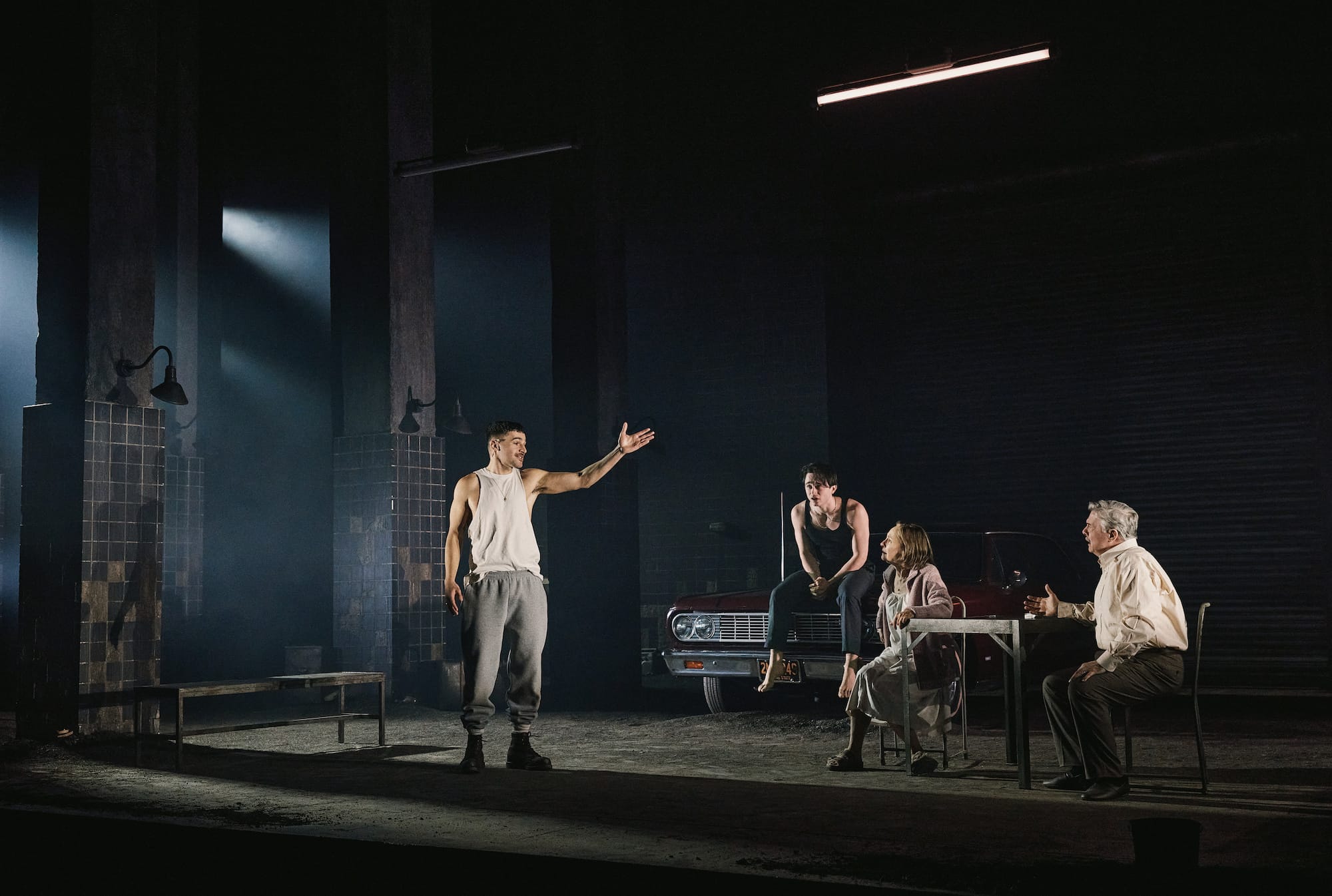
Mantello and scenic designer Chloe Lamford landed on a hollowed-out garage, industrial and graveyard-like with a beat-up rolling steel door, a quartet of pillars crusted in broken tile and lines of ashes piled to highlight the mid-century Chevy sitting center stage. “We kept thinking that there’s this central metaphor of a car,” Mantello explained. “Because this takes place in approximately 24 hours in his life — he arrives in a car, and he leaves in a car. And the idea of the garage [as] a liminal space … came later.”