









































Whenever prop master Andy Diaz starts working on a show with stage blood, he knows it’s a long road ahead. “There has to be a lot of conversations with a lot of people, different trials of different ideas, and, of course, a ton of cleanup,” he explained. “But all of that is what makes it so exciting. We play around and find what works. And then, when the trick works onstage, that audible gasp is just amazing.”
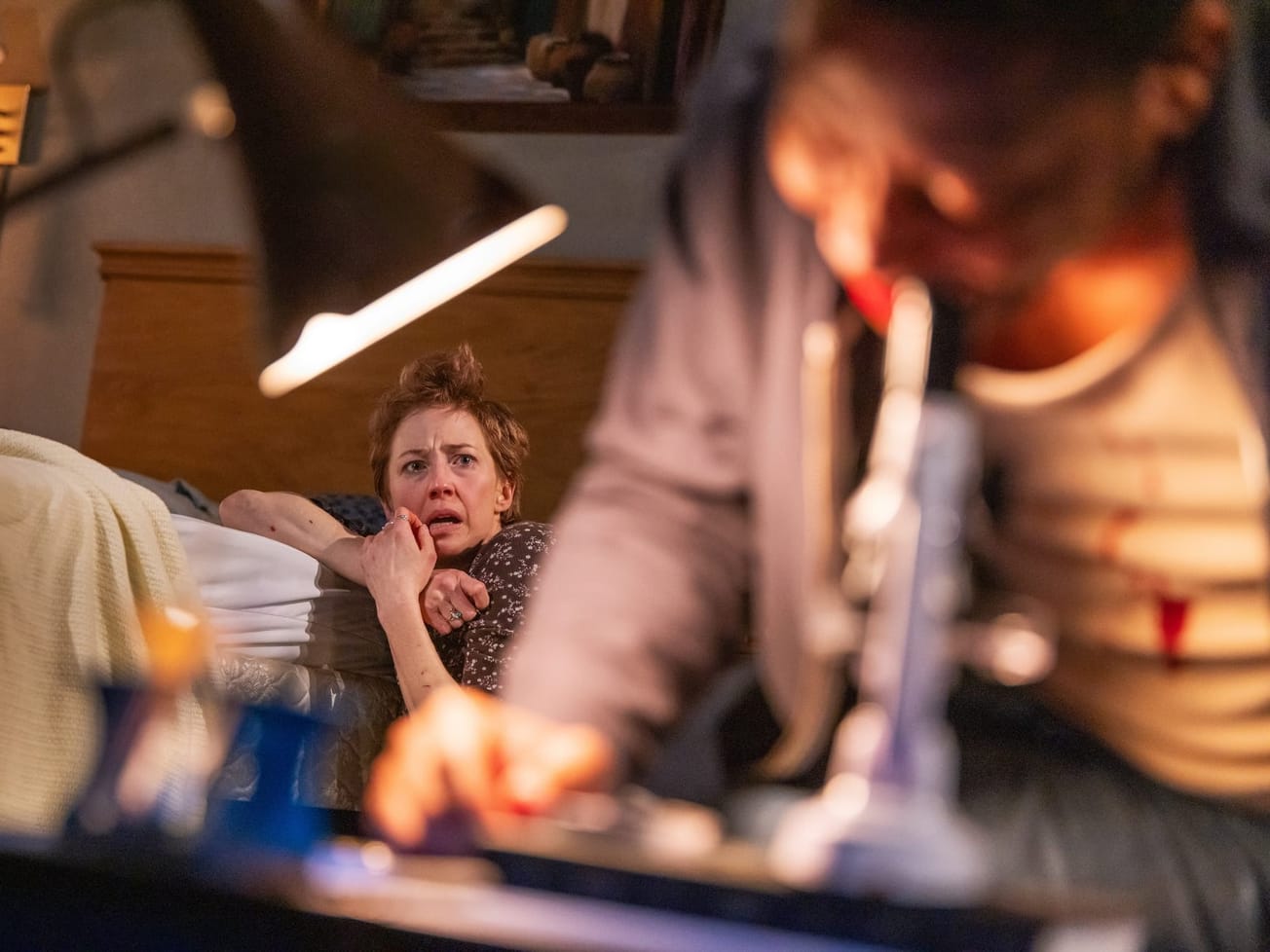
Such is the case with Diaz’s current production, “Bug.” Its gruesome stab effects required experimentation with hair and makeup designer J. Jared Janas regarding the placement of oozing wounds; costume designer Sarah Laux about how best to hide the blood pack — small packets of blood designed to burst on impact — on a performer’s body and the entire wardrobe department about spraying the clothes with water offstage so that the pack’s explosion pools quickly into giant patterns. Other bloody moments in “Bug” unfold thanks to strategic lighting design, precise blocking and the placement of tiny squirt bottles hidden around the set.
Each special effect with stage blood — and the subsequent audience reaction of shock and surprise — is a result of a collaboration across nearly every design department of a production. Properly performing a seconds-long effect is only possible because of months of planning, up to a week of preparation and hours of post-performance cleanup.
“In the movies and on TV, they only really have to do it once, and they can reset and redo it and then computer-generate it,” said Jennifer McClure, author of “Bloody Brilliant: How to Develop, Execute, and Clean Up Blood Effects for Live Performance.” “But in theater, we need to get it right, repeatedly, for however long we’re going to do it. And it has to work perfectly every single time.”
Building the blood effect
Creating a stage blood effect is such a joint effort because it involves so many variables. First, prop masters and illusions designers work with directors to define what the effect will look like. “I start by talking to directors as soon as possible because a ‘spurt,’ a ‘puddle’ or a ‘bloom’ might mean something different to me than you,” said McClure, who is also the properties supervisor for the Yale Repertory Theatre and the associate chair of technical design and production for the David Geffen School of Drama at Yale.