












































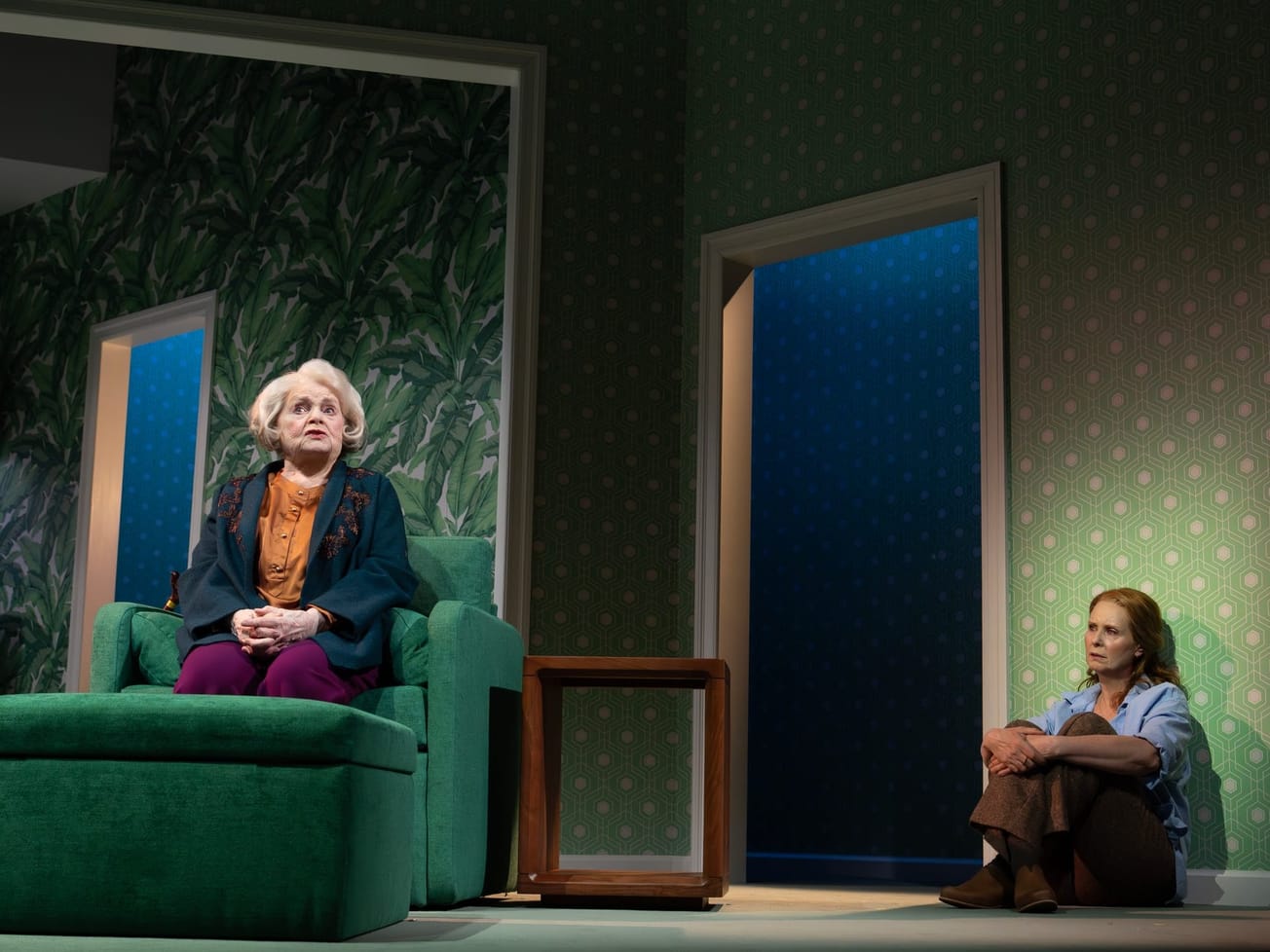
In 2009, playwright Jordan Harrison received a commission from Playwrights Horizons in conjunction with Theater Masters, which has a relationship with the Aspen Ideas Festival, a place to, quite literally, discover and flesh out ideas. The commission was tied to this theme. As Harrison recalled, “The only brief was: Write a play about big ideas.”
What resulted is “Marjorie Prime.” Harrison’s drama premiered with Los Angeles’ Mark Taper Forum in 2014 before debuting Off-Broadway in 2015 at Playwrights Horizons in a co-production with Chicago’s Goodman Theatre. This month, the play bowed on Broadway with Second Stage Theatre, officially opening at the Hayes Theatre on Dec. 8.
Today, Harrison’s play feels unfathomably relevant — though it was certainly ahead of its time in 2014. “Marjorie Prime” supposes a future in which humans never have to say goodbye to their loved ones — at least, not entirely. An invention, known as a “prime,” is a walking, talking AI version of a person which learns how to better become that person (and less like a blank computer hard drive) the more information the users provide. In “Marjorie Prime,” the titular character, played by June Squibb, is 85 and struggling with dementia. Marjorie gets a prime of her late husband, Walter — Walter Prime; he keeps her company and can also keep her memories present. Marjorie tells him stories about their life together that he will remember and be able to recite back to her when she forgets.
“Jon, who’s a character in the play, played by Danny Burstein, brings this computer into the space to deal with and hopefully improve upon dementia and memory,” noted director Anne Kauffman, who also helmed the play’s 2015 Off-Broadway mounting. “[A prime] can actually stitch together the memory that’s become disparate and has broken apart. And I love this idea, because I think all of us are so fearful — I definitely am —of Alzheimer’s, of dementia, of not recognizing our loved ones, never mind re-upping them in our lives.”
Still, through “Marjorie Prime,” Harrison questions the very purpose that memory serves in our lives and identities. “Marjorie is losing her memory and has forgotten certain things and there were very painful things in her life,” explained actor Cynthia Nixon, who plays Marjorie’s daughter, Tess. “Should we remind her of those things or should we hope that they make their way to the dustbin? And, similarly, with the prime of her husband, my dad, should we tell him those awful things that happened to keep the memory of those alive or shall we leave them out? Or, should we tell a fairy-tale version, which of course exists in families without AI [or] dementia?”
Beyond the role of memory, Harrison investigates humanity’s relationship to technology. As technology gains greater intelligence capabilities, should we use those abilities? Harrison has his finger on the pulse of existential concerns — but without judgment. “There are very few narratives where AI is a positive thing or at least questioning in real time whether or not it is,” Kauffman noted. “For me, this play is much more ambiguous [than other stories].”